
Integrated risk management
Integrated Risk Management versus GRC
GRC remains part of the picture. Integrated Risk Management becomes useful when risks, controls, assurance and actions need to connect across organisational boundaries.
Published by Hot Desk Consultancy Services Limited
Published Updated
The short version
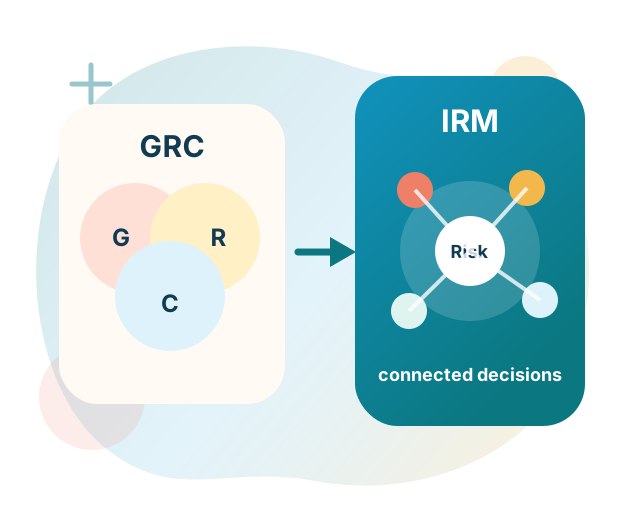
Governance, risk and compliance (GRC) are essential disciplines. Integrated Risk Management does not replace them. It connects them with wider risk domains, assurance, business continuity, remediation and the decisions people make across the organisation.
The label matters less than the way the work operates. A product can be called GRC or IRM and still leave teams with separate registers, duplicated controls and reports that require manual reconciliation.
What to compare in GRC software
When comparing GRC platforms, look beyond the label. Check which risks and obligations are covered, how controls connect to assurance evidence, whether actions have clear owners and whether leaders can make a decision without another round of spreadsheet reconciliation.
A focused GRC tool may be entirely suitable. The comparison becomes an IRM question when the same services, suppliers, assets, controls and actions need to remain visible across several risk domains.
A simple example
Consider a critical supplier that hosts an important business service. The supplier relationship may involve enterprise risk, cyber security, privacy obligations, contractual controls, continuity planning, assurance findings and remediation actions.
If those records sit separately, one team may accept a supplier risk without seeing an overdue security action or a failed continuity test. An integrated approach keeps the relationships visible. It does not force every team into the same process, but it gives decision-makers a shared view of the issue and the action being taken.
When a focused GRC scope may be enough
A focused scope can be sensible when the immediate need is clear: managing one compliance regime, improving an audit process, recording a defined set of controls or replacing a small register. A broader IRM programme is not automatically the right starting point.
The important question is whether that scope will support the decisions the organisation actually needs to make. If related risks, controls and assurance activity must still be reconciled elsewhere, the design should at least leave a path for connection later.
When the wider IRM view helps
IRM becomes more valuable when the same services, suppliers, assets and obligations appear across several risk domains; when control evidence is reused; when findings affect more than one risk; or when leaders need to see action across the whole environment.
This is as much about ownership and ways of working as it is about technology. Bringing every register into one tool will not solve inconsistent definitions, unclear authority or poor review habits.
Questions worth asking
- Which decisions are difficult because information is fragmented?
- Can we relate a risk to the controls, findings and actions that affect it?
- Do teams use compatible language and rating methods?
- Can leaders see who accepted a risk and when it must be reviewed?
- Would a focused improvement solve the problem, or simply move it?
Where Parapet fits
Parapet is Hot Desk's Integrated Risk Management platform. It supports connected work across enterprise and technology risk, compliance, audit, assurance, continuity and remediation.
Our IRM consultancy is not tied to a predetermined product outcome. The recommendation may be Parapet, another platform, better use of an existing system or no platform change.
Talk to us about your risk environment or read how to replace disconnected risk registers.
A note about this article
This is general information from Hot Desk Consultancy Services Limited. It is not legal, regulatory or procurement advice and does not assess a particular organisation or product.
Start a conversation
Bring us the challenge, not a finished specification.
We will help clarify the current state, the decisions that matter and a practical next step.