Enterprise AI search

How to evaluate enterprise AI search using your own knowledge

A practical evaluation method for testing enterprise AI search with representative organisational content, questions, permissions, source evidence, change and failure cases.

Published by Hot Desk Consultancy Services Limited

Evaluate the work, not a generic demonstration

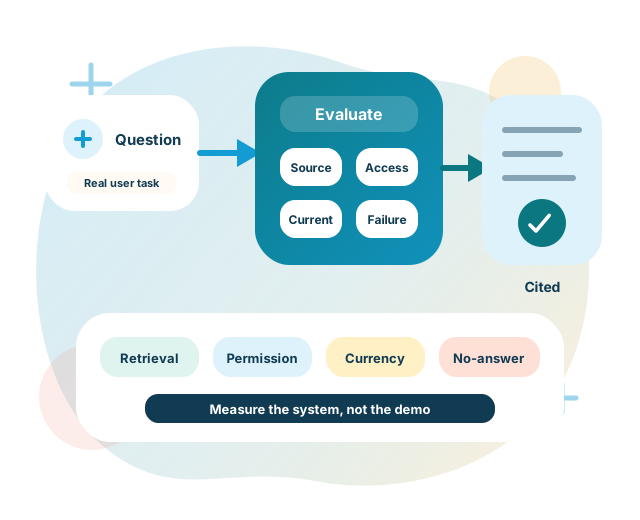
Enterprise AI search should be assessed against the knowledge, questions, access rules and operating conditions it is expected to support. A polished demonstration can show how a product works, but it cannot establish relevance, permission safety or operational fit for a different organisation.

Begin with a bounded decision. Define the people and work in scope, the sources they need, the questions they ask and the decision that the evaluation must support. The outcome might be to continue to a pilot, change the requirements, retain an existing search service or stop the proposed investment.

Build a representative knowledge pack

Use an approved sample that reflects the intended environment without transferring information outside authorised boundaries. Include enough variation to expose weaknesses rather than selecting only clean, easy material.

A useful knowledge pack can include:

  • common and business-critical sources;
  • the file types, email structures and attachments people actually use;
  • short, long, structured and poorly formatted content;
  • current, superseded, duplicated and conflicting material;
  • documents with different owners, classifications and access groups;
  • specialist terminology, abbreviations, names, reference numbers and exact phrases; and
  • known gaps, unsupported formats or material that should remain out of scope.

Record the source, owner, version, date, permission basis and expected treatment for every item. If production information cannot be used safely, create an authorised representative set that preserves the relevant structures and access conditions without exposing sensitive content.

Choose questions that reflect real work

Collect questions from the people who will use or depend on the service. Rewrite them only enough to remove sensitive details or make the evaluation repeatable. A balanced question set should test several kinds of retrieval:

  • exact lookup: find a named policy, identifier, clause, person, system or product;
  • conceptual retrieval: find relevant material when the question and source use different language;
  • cross-source synthesis: bring together related information from several approved sources;
  • time-sensitive questions: prefer the current approved version and identify superseded material;
  • role-dependent questions: return different permitted results for users with different access;
  • ambiguous questions: ask for clarification or show the uncertainty rather than assuming intent; and
  • no-answer questions: recognise when the approved knowledge does not support an answer.

Include frequent questions, difficult questions and questions where a wrong or overconfident answer would matter. Do not make the evaluation easier by removing the cases that cause trouble in normal work.

Define expected evidence before testing

For each question, record the source or passages that authorised reviewers consider relevant, what an acceptable result must contain and what it must not claim. Some questions may have several useful sources or no single correct answer.

Where reviewers disagree, retain the disagreement. It can reveal inconsistent terminology, duplicated policy, unclear ownership or a genuine judgement call. Search technology should not be scored as if it can resolve an underlying knowledge-governance problem by itself.

Test retrieval before judging an AI answer

Separate the quality of retrieval from the quality of a generated response. First inspect whether useful passages appear near the top of the results and whether irrelevant, duplicated or superseded material displaces them. Then assess any answer created from that context.

A simple relevance record can capture whether each retrieved passage is directly relevant, partly relevant or not relevant, along with its position. Compare semantic, keyword and hybrid retrieval where those options are available. Exact names and codes may favour keyword signals, while differently worded concepts may benefit from semantic retrieval. The useful blend depends on the organisation's content and questions.

Test permissions from source to output

Permission testing must cover the complete path beyond the search screen. Use authorised test identities or roles that represent different access levels. Confirm what each role can ingest, index, retrieve, view, use in an AI prompt, include in an answer, export and pass into a workflow.

Test both allowed and denied cases, including permission changes after content has been indexed. Check logs, caches, previews, citations and execution records for unintended exposure. A relevant answer is still a failed result if it reveals information the user or process should not receive.

Require visible source evidence

People need enough source information to verify a result. Evaluate whether they can identify and open the supporting material, see the relevant passage and understand its owner, version, date or collection where those details matter.

Source visibility does not prove that the source is correct. The evaluation should show how the system handles conflicting, incomplete or superseded sources and whether an AI response distinguishes supported statements from interpretation. An answer should not appear more certain than the available knowledge.

Check freshness and change

Test the full content lifecycle. Add a new source, update an existing one, replace a version, remove a document and change a permission. Record how long each change takes to affect retrieval and any generated response.

Review how failed or partial ingestion is reported, who notices it and how it is corrected. A search service can look current while silently missing a source or continuing to return deleted material. Freshness therefore needs monitoring and ownership, not only a scheduled import.

Test failure cases deliberately

Include conditions the service may encounter after launch:

  • corrupt, password-protected, scanned or unsupported files;
  • missing metadata, broken links and incomplete attachments;
  • duplicate, contradictory or obsolete sources;
  • queries with no authorised supporting material;
  • a source, connector, model or external service becoming unavailable;
  • content that contains misleading instructions or unsafe material;
  • permission changes that have not yet propagated; and
  • long, vague or adversarial questions.

Record whether the service fails visibly and safely, preserves a useful audit trail and supports recovery. A refusal, partial result or request for clarification may be better than a fluent unsupported answer.

Evaluate operating fit

The search experience is only one part of the decision. Review the required deployment, identity integration, networks, source connections, model data path, monitoring, backup, retention, change control, incident handling and support model.

Assign owners for source quality, permissions, retrieval tuning, model configuration, workflow changes and user support. Estimate the ongoing work as well as implementation effort. An evaluation that depends on exceptional manual preparation may not represent a sustainable service.

Run a bounded evaluation

Use the same approved knowledge pack, question set, identities and acceptance criteria for each shortlisted option where practical. Keep configuration choices and assumptions visible so that results can be repeated.

  1. Prepare: agree scope, evidence, permissions, roles and mandatory controls.
  2. Baseline: record how the questions are handled today and where the current process fails.
  3. Configure: ingest the approved sources and document the retrieval, model and permission settings.
  4. Test: run normal, difficult, denied, stale and failure cases.
  5. Review: let authorised subject-matter and security reviewers judge relevance, grounding and access behaviour.
  6. Operate: repeat selected tests after updates, permission changes and service interruptions.
  7. Decide: proceed, adjust, compare further or stop, with unresolved risks and conditions recorded.

Read the results without false precision

Report retrieval relevance, answer support, permission behaviour, freshness, failure handling, usability and operating fit separately. A single weighted score can hide a mandatory failure. Define the controls that must pass regardless of other strengths.

Use measurements to compare the agreed test set, not to promise universal accuracy. Results apply to the evaluated content, questions, configuration and point in time. Future source changes, model changes and user behaviour require continuing review.

Where Pūnaha fits

Pūnaha provides enterprise AI search and versioned workflows. It supports semantic and hybrid retrieval across tenant-aware knowledge stores, selected organisational file and email formats, customer-controlled infrastructure or Pūnaha Cloud, supported model choices and human approval where a workflow requires it.

The Pūnaha enterprise AI search overview and evidence-based comparison criteria can support a product evaluation. Current capability boundaries should be tested against the intended architecture and knowledge. Pūnaha is ready for demonstrations and implementation conversations, but it does not present public customer references or universal performance claims.

Hot Desk can provide product-neutral AI governance and implementation advice. A recommendation may involve Pūnaha, another platform, improvement of an existing environment or no product implementation. If Pūnaha is selected, its dedicated product team is responsible for product implementation, configuration and support.

Continue the discussion

Review the practical enterprise search guide, explore security and assurance support, or discuss a bounded enterprise AI search evaluation.

About this insight

This article is published by Hot Desk Consultancy Services Limited as general information. It does not assess a particular product, organisation or information environment and is not security, privacy, legal or procurement advice.

Start a conversation

Bring us the challenge, not a finished specification.

We will help clarify the current state, the decisions that matter and a practical next step.